Transportation

Performance Measures

Measuring progress to our goals.

SRPEDD's Performance Measurement Program

Performance measures are a valuable tool for building consistency, transparency, and accountability into transportation decision making. SRPEDD, as staff to the SMMPO, reports on progress towards meeting goals in key areas such as safety, infrastructure condition, congestion, system reliability, emissions and freight movement. The overall goal is to improve project decision-making and assist in more efficient investments of Federal transportation funds.

In 2016, the Federal Highway Administration (FHWA) established three performance measures—PM1, PM2, and PM3—which State Departments of Transportation (DOTs) and Metropolitan Planning Organizations (MPOs) are required to track. These measures focus on:

  • PM1: Improving safety,
  • PM2: Maintaining pavement and bridge conditions, and
  • PM3: Enhancing system efficiency, freight movement, reducing traffic congestion, and lowering emissions.

The Southeastern Massachusetts MPO (SMMPO) adopts the statewide targets for these performance measures and incorporates them into its decision-making processes, including project evaluation and programming. MassDOT reports progress on these metrics through its Annual Performance Management Report Tracker.

In parallel, the Federal Transit Administration (FTA) mandates that any Regional Transit Agency (RTA) receiving federal funds and managing capital assets must develop a Transit Asset Management (TAM) Plan. These plans guide how agencies manage assets to align with policy goals, improve accountability, support budgeting, and communicate priorities to stakeholders.

Additionally, RTAs receiving funds under the FTA’s Urbanized Area Formula Grants must prepare Public Transportation Agency Safety Plans (PTASP). These plans establish safety procedures, outline safety management processes, and include safety performance targets.

Safety

The SRPEDD Transportation Department adopted MassDOT’s statewide safety performance targets for 2018–2023. These targets are based on 5-year rolling averages using crash and traffic data per FHWA guidance. To support safety goals, both organizations continue to invest in Complete Streets, bike and pedestrian infrastructure, and intersection improvements through the Capital Investment Plan (CIP) and Statewide Transportation Improvement Program (STIP).

MassDOT’s long-term goal is “Toward Zero Deaths,” and it sets new safety targets each year for MPOs to adopt or replace with their own. The Joint Transportation Planning Group (JTPG) reinforced this commitment by adopting a Safe Streets and Roads for All resolution to support and develop a Regional Safety Action Plan targeting zero roadway deaths and serious injuries by 2050.

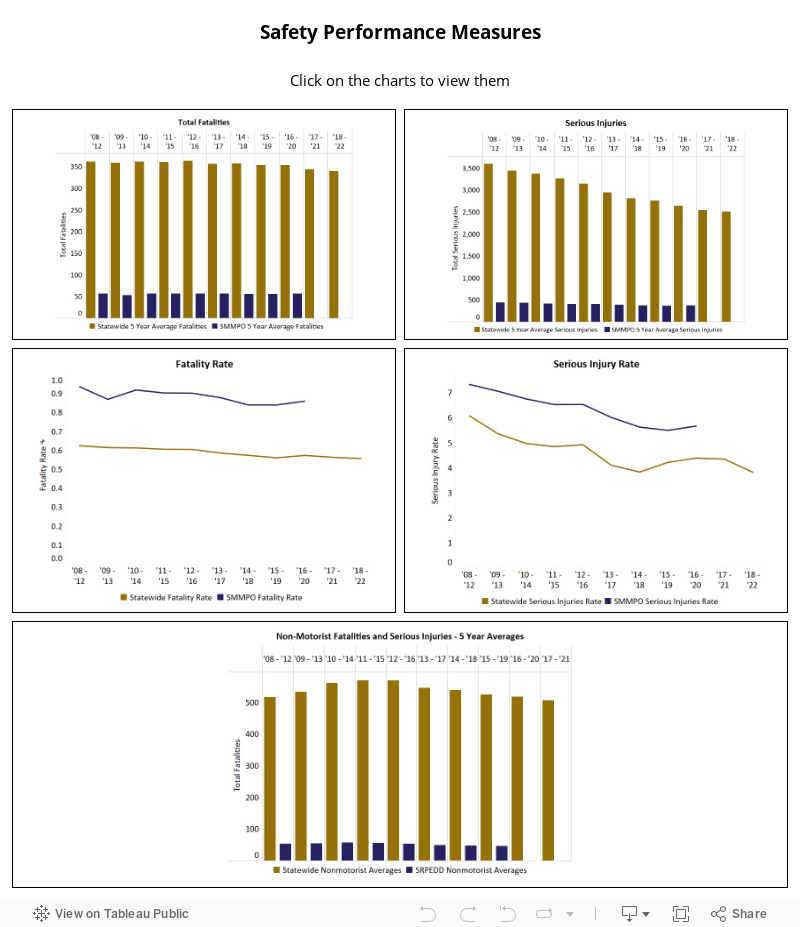
Per Federal Highway Administration (FHWA) guidance, the target number of fatalities for CY 2023 is set at 355, down from the 2017–2021 five-year average of 360 fatalities. The fatality rate target for CY 2023 is 0.59, which matches the five-year average for 2017–2021. While SMMPO’s total fatalities have remained steady across the last three reporting periods and show an overall decrease from historical numbers, the region’s fatality rate remains higher than the statewide rate. Earlier reporting periods showed a decline, but the most recent data (2016–2020) indicates a slight increase from 0.84 to 0.86.

For serious injuries, the CY 2023 target is 2,569 incapacitating injuries, down from the 2017–2021 five-year average of 2,626. The incapacitating injury rate target is 4.25 per 100 million VMT, slightly lower than the five-year average of 4.30.

For non-motorized users, which include pedestrians and bicyclists, the CY 2023 target for combined fatalities and incapacitating injuries is 437, reduced from the five-year average of 467 for 2017–2021.

Bridges and Pavement

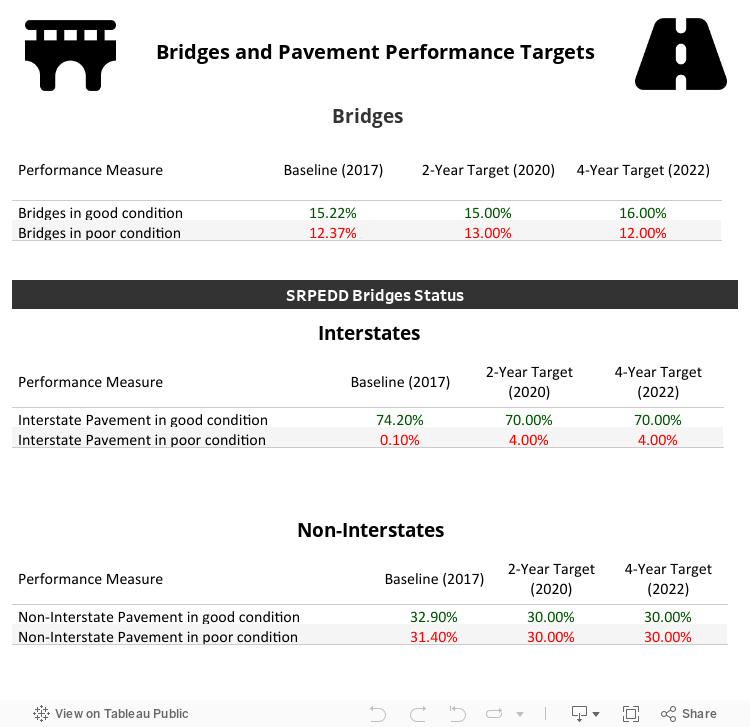
The SMMPO has adopted MassDOT’s 2-year (2024) and 4-year (2026) statewide performance targets for bridge and pavement conditions, as required by the Federal Highway Administration (FHWA). MassDOT established these targets in December 2022, and the SMMPO formally adopted them on February 21, 2023. These targets were developed following FHWA guidelines and are based on data from the National Bridge Inventory Standards (NBIS), the International Roughness Index (IRI), and assessments of pavement cracking and rutting. Six performance measures were set: the percentage of bridges in good and poor condition, the percentage of Interstate pavement in good and poor condition, and the percentage of non-Interstate National Highway System (NHS) pavement in good and poor condition.

Bridge targets were determined by evaluating programmed projects and projecting the rate of bridge deterioration, with performance measured by the percentage of total deck area rather than the number of structures. Pavement targets were initially based on a single year of data and are expected to remain steady until they are reassessed in 2024 using a fuller dataset. In addition to federal measures, MassDOT also monitors pavement quality using the Pavement Serviceability Index (PSI), which helps guide project selection and funding decisions.

Reliability, Congestion, and Emissions

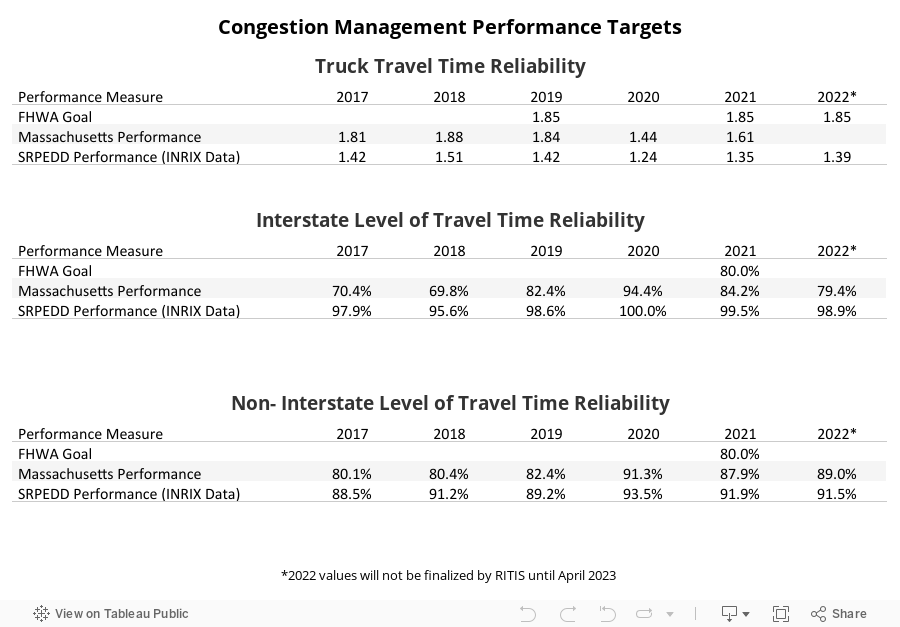
The SMMPO adopted MassDOT’s 2-year (2024) and 4-year (2026) performance targets for reliability, congestion, and emissions on January 17, 2023. These targets, developed in accordance with Federal Highway Administration (FHWA) guidelines, include measures for travel time reliability on the Interstate and non-Interstate National Highway System (NHS), and truck travel time reliability (TTTR) on the Interstate system. Using data from FHWA’s National Performance Management Research Dataset (NPMRDS), MassDOT assesses how consistently travel times compare between typical and slower conditions to determine system reliability.

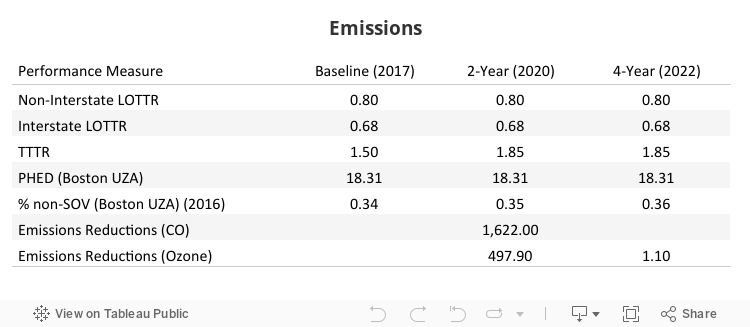
As part of the Boston Urbanized Area (UZA) and a signatory to the 2018 Boston UZA Memorandum of Understanding, the SMMPO also adopted regional congestion targets, including the percentage of non-single occupancy vehicle (non-SOV) travel and Peak Hour Excessive Delay (PHED). Non-SOV travel is measured using U.S. Census data and reflects the growing use of alternative commute modes. PHED is calculated by measuring excessive delay during peak hours and dividing it by the UZA population. For the Boston UZA, PHED targets are set at 24 hours for 2024 and 22 hours for 2026 to reflect expected post-pandemic improvements.

The percentage of non-SOV (single-occupancy vehicle) travel is measured using U.S. Census Bureau American Community Survey (ACS) Journey-to-Work data. This metric reflects the share of people commuting by modes other than driving alone. In the Boston UZA, non-SOV travel has been steadily increasing and is projected to continue growing at an annual rate of 1.4%.

Peak Hour Excessive Delay (PHED) is calculated as the total number of hours spent in excessive delay—defined as travel time at 20 mph or at 60% of the posted speed limit, whichever is greater—during peak periods (6:00–10:00 AM and 3:00–7:00 PM), divided by the total UZA population. For this reporting period, targets were developed using a trendline approach, accounting for post-pandemic uncertainties. In the Boston UZA, the 2024 PHED target is 24, with a more ambitious 2026 target of 22, which reflects improvement and falls below pre-pandemic levels.

Emissions reduction targets are based on the total projected emissions reductions from CMAQ-funded projects in air quality non-attainment or maintenance areas, as identified in the Statewide Transportation Improvement Program (STIP). These reductions are estimated using federally approved Congestion Mitigation and Air Quality (CMAQ) program methods.

Transit

Transit Asset Management Plans and Targets

Both Regional Transit Authorities (RTAs) operating in the SRPEDD region—the Greater Attleboro Taunton Regional Transit Authority (GATRA) and the Southeastern Regional Transit Authority (SRTA)—are classified as Tier II providers. According to the Federal Transit Administration (FTA), a Tier II provider is defined as a recipient that: (1) operates 100 or fewer vehicles in revenue service during peak periods across all non-rail fixed-route modes or in any one non-fixed route mode; (2) is a subrecipient under the Section 5311 Rural Area Formula Program; or (3) is a federally recognized American Indian tribe.

Tier II providers are required to develop a Transit Asset Management (TAM) Plan that includes an inventory of rolling stock, equipment, and facilities; a condition assessment of those assets; a prioritized list of investment needs; and annual performance targets and measures. Metropolitan Planning Organizations (MPOs) like the SMMPO are required to adopt these performance targets and incorporate them into their Transportation Improvement Programs (TIPs). SRTA’s current TAM Plans and associated annual performance targets were adopted by the SMMPO on April 18, 2023, and GATRA is currently in the process of updating its TAM Plan.

Transit Agency Safety Plans and Targets

On July 19, 2018, the Federal Transit Administration (FTA) published the Public Transportation Agency Safety Plan (PTASP) Final Rule, requiring certain public transportation operators that receive federal funding through the Urbanized Area Formula Grants program to develop safety plans that incorporate Safety Management Systems (SMS). This rule became effective on July 19, 2019, and mandates that transit agencies develop and maintain safety plans that include safety performance targets and are updated and certified annually.

Both GATRA and SRTA have developed agency-specific safety plans that include formal documentation outlining their approach to proactive safety management. These plans cover key elements of SMS: safety policy, safety risk management, safety assurance, and safety promotion. The SMMPO adopted current safety performance targets for GATRA and SRTA on March 21, 2023.