Coordinated Human Services Transportation Plan 2023
Southeastern Massachusetts Coordinated Human Services Transportation Plan
This plan was updated in 2023 to identify the transportation needs of individuals with disabilities, seniors and people with low incomes in Southeastern Massachusetts, provide strategies for meeting those needs, and prioritize transportation services for funding and implementation.
In 2007, the Safe Accountable, Flexible, Efficient Transportation Equity Act: A Legacy for Users (SAFETEA-LU) required that projects funded under Individuals with Disabilities, Job Access, and Reverse Commute Program (JARC), and New Freedom programs have a locally developed, coordinated public transit-human services transportation plan. In 2015, the Fixing America’s Surface Transportation Act (FAST Act) included recommendations to increase participation by recipients of Federal grants in locally developed, coordinated planning processes. Today, Federal transit law requires that projects selected for funding under the Enhanced Mobility for Individuals and Individuals with Disabilities (Section 5310) Program be “included in a locally developed, coordinated public transit-human services transportation plan” and that the plan be “developed and approved through a process that included participation by seniors, individuals with disabilities, representatives of public, private, and nonprofit transportation and human services providers and other members of the public.” The Southeastern Massachusetts Coordinated Human Services Transportation (CHST) Plan is being updated by the Southeastern Regional Planning and Economic Development District (SMMPO), staff to the Southeastern Massachusetts Metropolitan Planning Organization (SMMPO), to meet this federal requirement.” Through the FTA, the FAST Act provides funding for the Enhanced Mobility of Seniors and Individuals with Disabilities (Section 5310) funding program.
President Biden signed the “Infrastructure Investment and Jobs Act” (IIJA) into law on November 15, 2021. The Section 5310 program (previously authorized at $285.6 million) increased to $371.2 million in FY 2022 and will keep growing to $407.0 million by FY 2026. This program would be supplemented with an additional $50.0 million a year in general funds. The legislation makes no structural, formulaic, or programmatic changes to Section 5310.
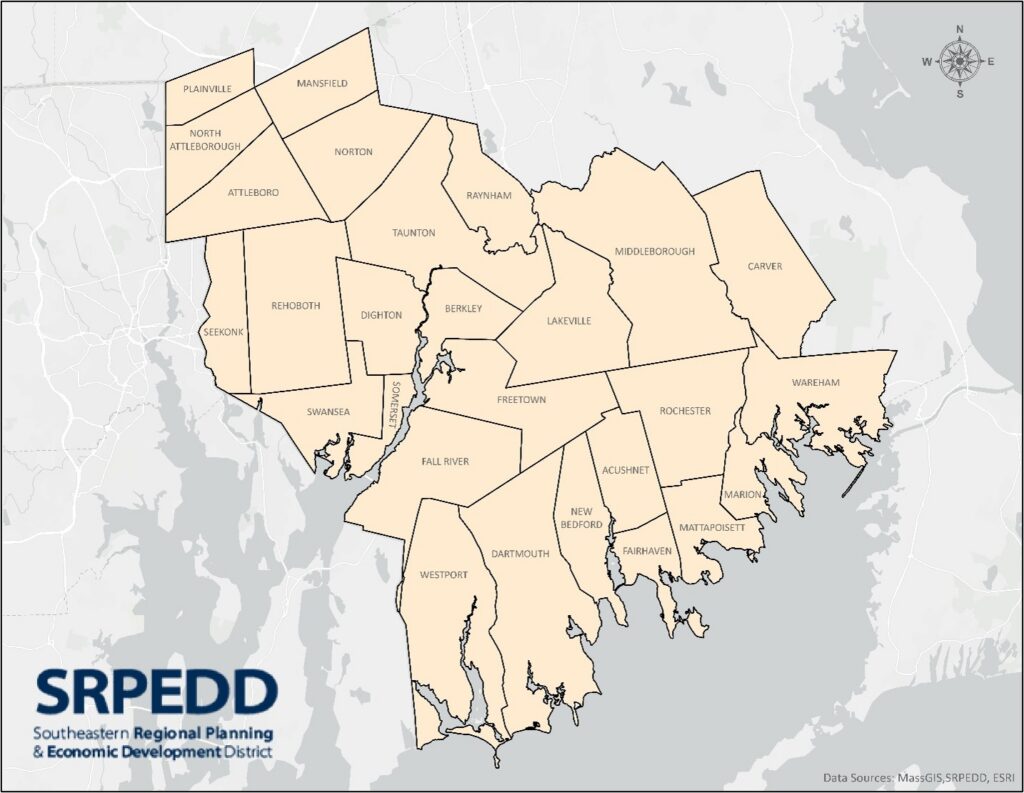
This Coordinated Human Services Transportation Plan covers the Southeastern Massachusetts Metropolitan Planning Organization’s planning area of 27 communities, as shown in Figure 1.
FTA defines a Coordinated Public Transit Human Services Transportation Plan as a “locally developed, coordinated transportation plan that identifies the transportation needs of individuals with disabilities, seniors and people with low incomes, provides strategies for meeting those needs, and prioritizes transportation services for funding and implementation.” FTA states that the plan must be “developed and approved through a process that included participation by seniors, individuals with disabilities, representatives of public, private, and nonprofit transportation and human services providers and other members of the public” utilizing transportation services. (FTA Circular C 9070.1G)
The goal of this CHST is to inform proposed projects so that they address one or more of the region’s transportation service gaps. This plan is part of an ongoing communication process between SMMPO, exiting transit users, and agencies who work with and advocate for various populations in the SMMPO region. Coordinated special needs transportation occurs when multiple organizations work together to their mutual benefit, taking advantage of existing infrastructure and systems, gaining economies of scale, eliminating duplication, enhancing efficiency, expanding, and/or improving the quality of service to better address the transportation needs of the special needs population.
Coordination among different transportation service providers and local governments makes the most efficient use of limited transportation resources by avoiding duplication caused by overlapping individual program efforts and encouraging the use and sharing of existing community resources.
The required elements of a Coordinated Plan has four parts:
- An assessment of available services that identifies current transportation providers (public, private, and nonprofit).An assessment of transportation needs for individuals with disabilities and seniors. This assessment can be based on the experiences and perceptions of the planning partners or on more sophisticated data collection efforts, and gaps in service.Strategies, activities, and/or projects to address the identified gaps between current services and needs, as well as opportunities to achieve efficiencies in service delivery.Priorities for implementation based on resources (from multiple program sources), time, and feasibility for implementing specific strategies and/or activities identified.
Individuals with special transportation needs are unable to transport themselves due to age, income, or health condition. The transportation disadvantaged have different types of transportation requirements as they travel to work, school, internships, medical appointments, religious services, shopping, social activities, etc.
The Southeastern Massachusetts CHST plan identifies those with special transportation needs, provides strategies for meeting those needs, and prioritizes transportation services and projects for funding and implementation. Any local projects proposed for federal funding under the Enhanced Mobility of Seniors and Individuals with Disabilities funding program (Section 5310) must be included in this CHST plan. Section 5310 formula grants is funding allocated for urbanized and rural areas based on the number of seniors and individuals with disabilities within these areas.
The goal of Section 5310 funding program is to improve the mobility for older adults and people with disabilities by providing capital projects that are planned, designed, and implemented to meet their needs. The program provides formula funding to states for the purpose of assisting private nonprofit groups in meeting the transportation needs of older adults and people with disabilities when the transportation service provided is unavailable, insufficient, or inappropriate to meeting these needs. Funds are apportioned based on each state’s share of the population for these two groups.
The Section 5310 program was established in 1975, prior to the Americans with Disabilities Act (ADA) of 1990. Through the FAST Act, funding is available for capital, operating, and mobility management projects and services. In Massachusetts, the state funded Mobility Access Program (MAP) is used to provide capital funds for accessible vehicles, computers, and communication equipment in a competitive selection process to eligible recipients.
Communication and input from seniors, individuals with disabilities, public, private, non-profit, and human services transportation providers, as well as the general public plays a critical role in the development of this plan. The needs outlined in this plan have been identified through a variety of input including in person and virtual meetings, digital and paper surveys, regional transit agencies, public and agency surveys, etc. Communication and input was received from the following:
- State and human service agenciesRegional Transit AuthoritiesCommunity and local collegesIndependent Living CentersCouncils on AgingCareer CentersCity/Town Human Service departmentsTown OfficialsEconomic and Community Development agenciesNonprofit social service agenciesTransportation providersVeterans’ organizationsCareer Centers, Workforce Investment Boards, and employment/staffing agenciesSRTA’s Comprehensive Service Assessment, January 2021 (includes stakeholder and public input, comments, and survey results)GATRA’s Comprehensive Service Assessment, January 2021 (includes stakeholder and public input, comments, and survey results)CHST Public Unmet Transportation Needs Survey, March 2023CHST Agency Unmet Transportation Needs Survey, February 2023GATRA’s Ride Match search data (2012-2022)Presentation and request for feedback at SMMPO’s Joint Transportation Planning Group on January 11, 2023.And other community members
The plan and process of the update were presented at a meeting of the Joint Transportation Planning Group (JTPG) on January 11, 2023. An article regarding the CHST Plan update was also advertised in the January SMMPO Newsletter. The Draft CHST Plan will be presented to the JTPG and Southeastern Massachusetts Metropolitan Planning Organization (SMMPO) meetings in June. Public meetings to present the 2023 Draft CHST Plan will be held at each respective library and take place in Attleboro on May 8th, New Bedford on May 11th, Fall River on May 17th, and in Taunton on May 23rd, paper copies of the plan will be made available at all four meetings. While the 2023 Draft CHST Plan will be available on the SMMPO website, paper copies will also be provided to any individual or organization as requested.
Maps of the SMMPO region’s population statistics of older adults, persons with a disability, poverty, unemployment, and housing units with zero vehicles available are provided below. Population data was compiled using the 2020 Decennial Census, while all other data was compiled using the 2017-2021 American Community Survey. 2020 Decennial Census tract geography was used for all data. Please reference Appendix A for all demographic maps.
Population Density
Overall, population density is highest in the cities of New Bedford and Fall River. The city of Taunton, as well as the towns of Mansfield, Middleborough, and North Attleborough also have areas of a high population density.
Population with a Disability
Population with a disability is highest in nine different communities. Attleboro, Dartmouth, Carver, Fall River, Plainville, Taunton, Seekonk, Wareham, and Westport all have at least one census tract showing at 1,000 or more persons with a disability. Fall River, and Wareham have more than one census tract with 1,000 or more persons with a disability.
Population below Poverty Level
Population below poverty level is highest in the downtown areas of New Bedford, Fall River, and Taunton with 40 to 50 percent of the population below poverty level. Downtown Attleboro as well as downtown Middleborough (30% - 40%) also have higher areas of low-income populations compared to the other SMMPO communities.
Unemployment Rate
The unemployment rate for the civilian labor force age 16 and older is highest in Fall River and New Bedford with census tracts showing an unemployment rate of 15 to 21 percent. Additional communities with a high unemployment rate (10% - 15%) include Attleboro, North Attleborough, Taunton, and Wareham.
Older Adults
Population age 60 and older is prevalent within all of SMMPO. Each of SMMPO’s 27 communities have at least one census track with 800 or more persons aged 60 or older. Most dominant with 2,000 or more persons age 60+ are the communities of Attleboro, Carver, Dartmouth, Mattapoisett, Middleborough, Plainville, Seekonk, Somerset, Taunton, Wareham, Westport. Population age 75 and older is most dominant, with at least 800 persons, in the towns of Carver, Mattapoisett, and Somerset; and population age 85 and older are most prevalent, with at least 400 persons, in the town of Somerset.
Provider Inventory Resources
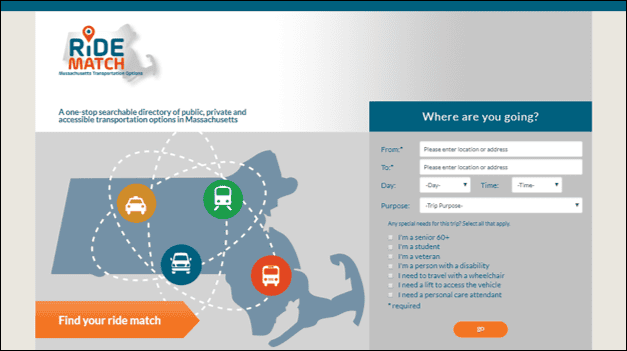
The Greater Attleboro Taunton Regional Transit Authority (GATRA) hosts and maintains a one-click mobility management website called Ride Match (www.massridematch.org). Ride Match is a regional directory of transportation options (private, public, and non-profit) for older adults, people with disabilities and anyone needing to travel in Southeastern Massachusetts and beyond. Ride Match search function analysis for the past 5 years (2017-2022) shows that most searches came from the cities of Attleboro (335) and Taunton (575), while top searches were to Boston (576) and Taunton (455).
The MassMobility initiative is an initiative to increase mobility for older adults, persons with disabilities, veterans, low-income commuters, and others who lack transportation access in Massachusetts. Although MassMobility does not provide any transportation services, they do offer information to help people find transportation services in their area. MassMobility is also available to provide technical assistance to organizations, municipalities, and others looking for transportation coordination resources. More information about MassMobility can be found at https://www.mass.gov/orgs/massmobility.
Existing Transportation Options
Greater Attleboro Taunton Regional Transit Authority (GATRA)
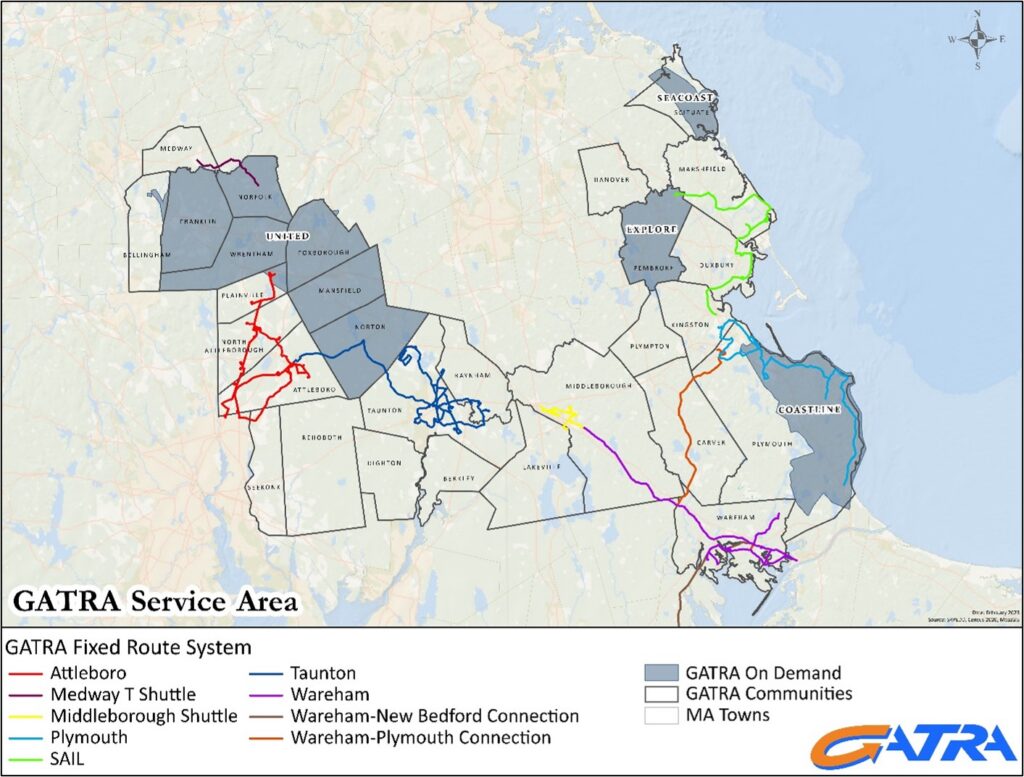
The Greater Attleboro Taunton Regional Transit Authority (GATRA) operates across a 29-member community service area located in southeastern Massachusetts between Rhode Island and the south shore coastline (figure 3). Within the SMMPO region, GATRA provides year-round accessible fixed route bus service in the cities of Attleboro and Taunton that extends into Raynham, Norton, Plainville, North Attleborough, and Seekonk. Fixed route bus service is also provided in Wareham. In addition to the fixed route bus service mentioned above, GATRA provides three inter-community routes originating in Wareham: 1) Wareham to the Lakeville/Middleborough MBTA station, 2) Wareham to Colony Place in Plymouth, and 3) Wareham to downtown New Bedford. For the past several years, GATRA has contracted with SRTA to provide service from Wareham to New Bedford. From social services in New Bedford to shopping in Plymouth each of these intercommunity routes have brought a much-needed connection to those residing in Wareham. Outside of the SMMPO region GATRA provides fixed route service in Plymouth, Kingston, Duxbury, Marshfield, and Pembroke.
Over the last few years, GATRA has initiated several on-demand, microtransit services. Within the SMMPO region, GATRA GO United provides on-demand, same day service to the towns of Norton, Mansfield, and extending slightly into Plainville. GATRA GO United also includes the towns of Foxborough, Franklin, Norfolk, Wrentham, and extends slightly into Bellingham. Outside of the SMMPO region, GATRA’s on-demand service includes, GATRA GO Explorer in Pembroke, GATRA GO Seacoast in Scituate, and GATRA GO Coastline in Plymouth.
GATRA offers ADA paratransit service to persons with disabilities within ¾ mile of a fixed bus route as well as community-wide dial-a-ride service for older adults and persons with disabilities of any age in all 29 GATRA communities.
GATRA also offers limited non-emergency long distance medical transportation through the Med Wheels program. This service is available to seniors and people with disabilities in any of GATRA’s 29 communities. This program is grant funded using state and local funding sources.
Although outside of the SMMPO region, Miles for Health is another medical transportation service provided by GATRA. Miles for Health-Long Distance is a shared long distance medical transportation service for seniors and people with disabilities. This service however is only available for residents in the towns of Franklin, Foxborough, Norfolk, and Wrentham. This service provides scheduled medical transportation to Worcester, Boston, Needham, Framingham, Dedham, Natick, Wellesley, and Brockton. Miles for Health-Local is a shared local medical transportation service for senior and people with disabilities. Miles for Health-Local provides medical transportation to facilities within a 15-mile radius of Franklin, Foxborough, Norfolk, and Wrentham.
With the support of the Human Transportation Services (HST) unit, MassHealth is able to provide transportation to MassHealth covered services for eligible individuals. GATRA provides these contracted transportation services which includes, but is not limited to, medical, dental, mental health, and substance use disorder appointments, as well as transportation to and from Day Habilitation programs. GATRA contracts with transportation vendors and provides brokerage service in Southeastern Massachusetts for eligible consumers of MassHealth (for Medicaid recipients), Department of Developmental Disabilities (for DDS and Day Habilitation Program clients), Department of Public Health (for children receiving Early Intervention services), Massachusetts Rehabilitation Commission, Massachusetts Commission for the Blind, and the Department of Mental Health.
Southeastern Regional Transit Authority (SRTA)
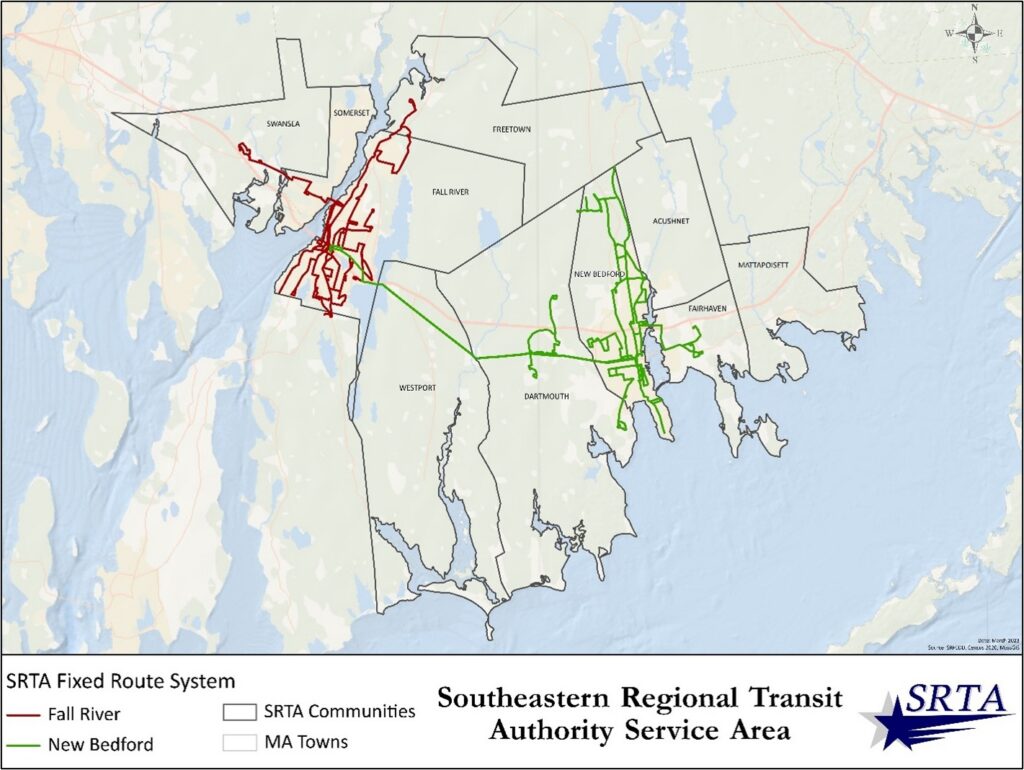
The Southeastern Regional Transit Authority (SRTA) operates across 10-member communities, all within the SMMPO region (figure 4). SRTA provides fixed route bus service in the cities of New Bedford and Fall River, that extends into the towns of Fairhaven, Dartmouth, Westport, Somerset, and Swansea.
ADA paratransit service is available in all ten SRTA communities for persons with disabilities seven days a week and until 10:00PM Monday-Friday.
As a result of coordination between SRTA and the COAs in their region, long distance medical transportation is available, primarily, to older adults, veterans, and persons with a disability within all of SRTA’s ten communities. This service runs between New Bedford (on Tuesdays)/Fall River (on Thursdays) and Boston, with 11 different Boston hospitals being served.
Councils on Aging (COAs)
Most COAs in the GATRA region have a contract with GATRA to provide ADA and/or Dial-a-Ride service to persons with disabilities and older adults with GATRA vans. Some COAs also have their own vans and provide local group trips to grocery stores and recreational activities.
In the SRTA area, COAs provide transportation to older adults in their cities/towns. In many of these communities, COAs are the only providers of affordable curb-to-curb transportation to medical appointments, shopping, and other trip types for those who either can’t ride a fixed route bus or live in an area not served by the transit authority.
Commuter Bus
Intercity bus service provides scheduled connections between cities within Massachusetts and to cities in neighboring states. Unlike local transit bus service, intercity bus service has minimal stops along its route. Within the SMMPO region, there are two private bus companies that provide intercity bus service, Blue Apple Bus Company, and Peter Pan. Bloom’s Bus Lines suspended their commuter bus service from Taunton to Boston in March 2020, due to the COVID-19 pandemic and do not anticipate restoring this service. Until April 16, 2023, DATTCO operated commuter service between Fairhaven/New Bedford/Taunton and Boston. DATTCO abruptly ended this service on April 16, 2023, giving roughly a month’s notice to passengers. Both Bloom’s Bus Lines and DATTCO cite declining ridership since the COVID-19 pandemic as regards to why the service ended.
Peter Pan Bus Lines
Peter Pan Bus Lines offers several commuter service lines in the SMMPO region. Service between Boston – Hyannis – Fall River provides service from Sagamore, Barnstable, Hyannis, or Bourne to New Bedford and Fall River. Service is also provided from New Bedford and Fall River to Boston, Providence, and New York.
Due to DATTCO’s abrupt end of New Bedford to Boston service, and at the request of MassDOT and local representatives, Peter Pan decided to offer a replacement service from New Bedford to Boston. Peter Pan began operating this service on April 18, 2023, adding stops in Fall River and at Logan Airport. Peter Pan’s commuter service offers one morning trip from Fall River - New Bedford –Taunton to South Station and Logan Airport in Boston, and one evening trip in the reverse. Peter Pan stated that more trips could be added if ridership prevails.
Blue Apple Bus Company
Blue Apple Bus Company provides an airport express roundtrip service from the Mansfield MBTA station to Boston’s Logan Airport. This service launched in November 2022 with ten daily round trips from 3:00 AM to 9:00 PM. In January 2023, Blue Apple Bus Company announced an additional five roundtrips to Logan for a total of 15 round trips from 3:00 AM to 1:00 AM. Blue Apple Bus Company anticipates increasing to 20 roundtrips in the near future. There is available parking at and around the Mansfield MBTA Station as well as the at two private-owned parking lots known as Ditchman Parking Lot and Foundry Parking Lot. This new service is a public-private partnership with the support of the Town of Mansfield, GATRA, MassDOT, MBTA, and others.
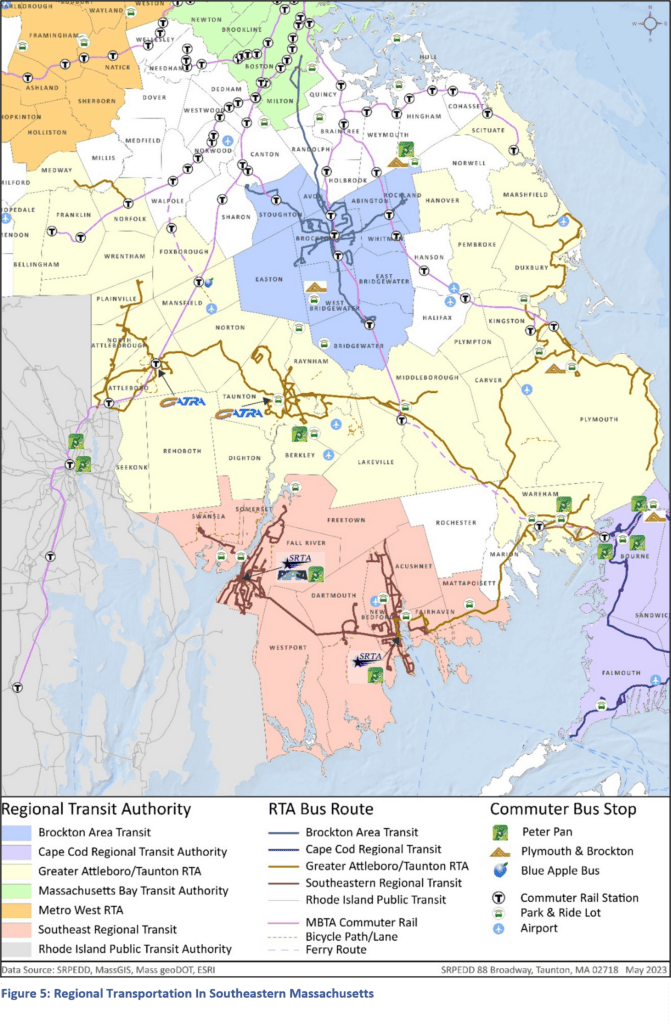
More transportation providers are available on the Ride Match website at www.massridematch.org. Please reference figure 5 for a transportation services in southeastern Massachusetts.
Unmet Transportation Needs Survey
In February and March of 2023, SRPEDD conducted agency and public surveys to obtain and record unmet transportation needs in the SMMPO and Southeastern Massachusetts region. In February, CHST stakeholders that represent human service agencies, municipalities, social service agencies, and non-profit organizations across the SMMPO region were sent a survey. In addition to the agency survey, SRPEDD rephrased the questions for direct public transit and transportation users. In March, the public survey was distributed via all stakeholders as well as on SRPEDD’s Facebook Page, which was shared by other organizations. Paper copies were available upon request. The public survey was available in English, Spanish, Portuguese, Haitian Creole, Mon Khmer/Cambodian, Traditional Chinese, and Simplified Chinese. Surveys were received in English, Portuguese, and Spanish.
Agency Survey Results
The agency survey was completed by a total of 25 agencies. Most respondents were from councils on aging, and organizations serving people with disabilities and/or low incomes. Of the 25 agency survey respondents, 76% provide transportation to their clients either directly or through the purchasing of transportation. The majority of agencies, 56%, do not provide travel training, however 12% would like to. Of those who responded, the survey identified the top five towns in Southeastern Massachusetts with the highest unmet transportation needs (in order of priority) as: Taunton, Dighton, Fairhaven, Attleboro, and Mattapoisett. When asked to rank trip purpose in order of unmet need medical, employment, and shopping were the top three unmet needs. Nine of the agencies had over 50 clients in the last 12 months with who they worked with that had unmet transportation needs. The majority of agencies (60%) surveyed also reported that their clients are missing work or medical appointments in the last 12 months due to transportation needs. When asked what recommendations public transit services could make, agencies responded with expanding hours of operation, expanding bus routes, connections between Regional Transit Authorities, etc. Agencies were also asked about the impact the COVID-19 pandemic has had on their clients. Responses varied, but some common themes were driver shortages, fear of using public transit, increased need for food assistance, ending of day care programs, economic hardship when free fares ended, and elimination of classes for older adults/feeling isolated. For complete results on the agency survey please see Appendix B.
Public Survey Results
The public survey was completed by a total of 53 respondents. Survey respondents represented several cities and towns with Taunton and New Bedford each accounting for 26% of survey respondents and North Attleborough accounting for 23% of total survey respondents. The majority of respondents (35%) identified as older adults (aged 60 and over) and/or individuals with low-income (25%). When asked how respondents currently get around, 41% primarily use their own vehicle, 32% use public transit, and 28% use someone’s vehicle or get a ride. Respondents reported that they had missed a medical appointment (42%) or had missed work (23%) in the last 12 months due to lack of transportation. The top five cities or towns respondents have the hardest time getting to are (in order of difficulty) Boston, Fall River, Providence, Taunton, and Burlington. Medical transportation continues to be the largest unmet transportation need, followed equally by education and recreation/exercise. Survey respondents (58%) are generally interested in travel training. For complete results on the public survey please see Appendix C.
Unmet Transportation Needs
When asked if there are destinations in Southeastern Massachusetts that people could not reach because of the lack of transportation, 64% of the agencies and 51% of the individuals who responded to the question answered yes. Respondents identified the following destinations and needs that could not be reached because of a lack of transportation:
Medical appointments in general and specifically in:
- Brockton
- Dighton
- Easton
- Fall River
- Foxborough
- Mansfield
- Plymouth
- Taunton
- Wareham
Hospitals/Medical Centers, specifically:
- Sturdy Memorial Hospital
- Attleboro
- Boston area hospitals and medical centers
- Brockton VA Medical Center, Brockton
- Brockton Hospital
- Cape Cod Medical Center
- Good Samaritan Medical Center, Brockton
- Charlton Memorial in Fall River
- Brigham & Woman’s, Foxborough
- Providence VA Medical Center
- Providence area hospitals o Goddard Hospital, Stoughton
- Morton Hospital, Taunton
Industrial Parks, specifically:
- New Bedford Industrial Park
- Myles Standish Industrial Park, Taunton
Education:
- Bridgewater State University
- Bristol Community College, Fall River
- Massasoit Community College, Brockton
Intercity/Intercommunity connections
- Assonet to Taunton (Assonet to anywhere)
- Fall River to Taunton / Taunton to Fall River (Specifically downtown Fall River and BCC to downtown Taunton, Morton Hospital, and Myles Standish Industrial Park)
- Fall River to Brockton (Specifically downtown Fall River and BCC to downtown Brockton, Massasoit, courthouse, VA Medical Center.)
- Fall River to Boston
- Fall River to Providence
- Norton to Attleboro and North Attleborough
- Raynham to Boston
- Taunton to Boston
- Taunton to Bridgewater
- Taunton to Brockton
- Taunton to Easton
- Taunton to New Bedford
- Taunton to Plymouth
- Taunton to Providence
- Swansea to anywhere
- Attleboro, specifically downtownBrockton, specifically the Arc of Greater Brockton,Boston, specifically US Immigration CourtBurlingtonEaston, specifically TargetFall River, specifically Arbour CounselingNeedhamNew Bedford, specifically Herman MelvilleMiddleboroughPlymouthProvidence, specifically USCIS Application Support Center, Providence Place MallRaynham, specifically AldiSouth Attleboro, specifically CVS pharmacyTaunton, specifically downtown and DTA officeT.F. Green Airport, Warwick, RIWest Bridgewater, Market Basket
Survey Trends
- The overall need for transportation continues to increase.As the population of Southeastern Massachusetts continues to age, the need for transportation to and from medical appointments is rapidly increasingLack of connection between cities and towns (i.e., Taunton to Brockton, Fall River to Providence) creates a barrier for ridersNeed for better connection between local fixed routesNeed for expanded transit early morning and evening hours during the week as well as Saturday and Sunday serviceCertain areas lack long-distance medical transportationMedical and Employment transportation needs continue to dominate out as the most critical unmet transportation need
Service Gaps and Regional Needs that have been identified in the SMMPO Region
Extended Service Hours
Transit hours of operation are not adequate to address the primary types of employment in the area. The need for evening and weekend service has been repeatedly expressed by communities and individuals throughout the region and is considered to be a top priority transit need. Many jobs filled by low-income individuals are in retail, manufacturing, warehousing, and services. Companies in the manufacturing and medical service sectors often have second and third shifts. The fact that bus service in some areas ends early in the day has also limited the number of high school students that seek internships after school through school-to-work programs.
Transportation to Surburban Jobs and Other Employment Transportation
Employment in the region is rapidly growing outside of existing transit service areas, which are primarily in the four cities (New Bedford, Fall River, Taunton, and Attleboro). New development, primarily medical, warehousing and retail, continues to occur in suburban towns that have limited or no transit service. Access to this development and the employment it creates cannot be served efficiently by traditional fixed route service. This suburban sprawl strains existing transit route systems and much of this development is unserved or underserved by transit. Alternately, there is also a need for those that live in suburban areas unserved by fixed routes to get to urban areas for medical, employment, and educational needs.
There is a need for expanded general use on demand transportation to get people to employment locations. The lack of flexible, reliable transportation is hindering the ability to get and keep employment. Partnering with ride sharing companies to provide expanded hours, first/last mile connections, and guaranteed ride home services to complement the existing transit service would strengthen the transportation network and benefit regional transit, riders, and employers.
Low-income individuals who are seeking employment need assistance with public transportation passes in order to get them to/from employment agencies, job interviews, and other social and human service appointments. There is a growing need for financial assistance to support transportation for individuals seeking employment that occurs prior to the individual finding work.
Large Industrial Parks
Most industrial/business parks in the region receive some level of transit service, but it is inadequate for many workers. Parks are usually located on the outskirts of the city and cover tens or hundreds of acres. Roadways are not designed for transit service and there are often no sidewalks for pedestrians. Providing better service to these locations is a challenge to the existing transit systems.
Geographical Service Connections
Many gaps exist in the transit system within the SMMPO region, as well as from the SMMPO region to other regions and across the Rhode Island state line. Connections are needed to bridge the transit gaps between urban areas to cover the entire SMMPO area and beyond, whether it is connecting SRTA with GATRA, GATRA with BAT, GATRA and SRTA with RIPTA or connecting local bus service to commuter bus or commuter rail. Gaps exist for both fixed route and paratransit services. Where there is no fixed route service, paratransit services are usually limited to areas within each town. Providing connections to other transit services would help to expand mobility and access for persons with disabilities, for people seeking employment and for others.
Connecting cities and/or towns in Southeastern Massachusetts is needed. New service and/or additional service is needed for travel between:
- Attleboro and Fall River
- Fall River and Taunton
- Fall River and Brockton
- Fall River and Boston
- Fall River and Providence
- Taunton and Brockton
- Taunton and New Bedford
- Taunton and Boston
- Taunton to Plymouth
- Taunton and Providence
- Wareham and New Bedford (beyond the Wareham-New Bedford Connection)
Infrequent Transit Service
Where fixed route service exists in the GATRA service area, it is usually at a one-hour frequency, which is inadequate for most people, especially those making work trips. The current fixed route SRTA service also operates at one-hour headways on certain routes outside of the urban centers of Fall River and New Bedford.
Mobility Training and Education about Existing Services
Agency surveys indicate that 61% of agencies do not provide travel training while 62% of those who took the public survey stated they are interested in travel training. Travel training on how to use fixed-route public transportation independently and safely provides people with disabilities, older adults, persons with limited English proficiency, as well as others with convenience, increased independence, and a sense of self confidence for these individuals.
GATRA has a travel training program and a dedicated travel trainer who travels across the region and does one on one and group travel training sessions. This service provides those in the GATRA region with the opportunity to familiarize themselves with the service and truly take advantage of it. SRTA currently does not provide travel training, however there is a great need for travel training and education about available services in the SRTA service area.
Throughout the SMMPO region there is a consistent need for education and information about existing transit and community transportation services. There is also a need to communicate information to non-English speaking, or illiterate populations. Mobility management projects would help address these needs.
Child Care Transportation
Even if transit is paid for, it is difficult for parents who do not have a car to arrange to drop off children on their way to work and pick them up on the way home. Coordinating child care and employment transportation is an obstacle for many people trying to transition from welfare to work. Locating child care at transit centers or at employment centers is one option.
Long Distance Medical Transportation
The need for long distance transportation exists throughout the region. For those with certain MassHealth plans, transportation service to/from medical appointments exists. Beyond that there is a dire need to get to local, neighboring town, and long distance (specifically Boston) medical appointments. Ride Match search function analysis for the past 10 years (2012-2022) shows that there have been over 1,000 searches for transportation between locations in southeastern Massachusetts and Boston.
Additional Unmet Needs
- Transportation in rural areas and communities no served by traditional transit. Seniors in rural areas have a difficult time finding transportation to shop for essentials, engage in social activities, visit family, etc.Older, disabled elders who are frail and who need extra assistance for all trips require service beyond the curb-to-curb transportation that is currently available.Transportation specific to educational destinations across southeastern MA and in the surrounding regions. Specifically, Bristol Community College locations in Fall River, Taunton, and Attleboro; Massasoit Community College in Brockton; and Cape Cod Community College in HyannisTransportation for low-income youth to/from medical appointments during school hours and to/from after school programs for students whose parents do not own a vehicle.Transportation from long-term drug treatment facilities to required court appearances.Transportation to homeless shelters.
Proposals to address the above service gaps should have affirmative answers to the following questions in order to receive consideration for funding.
- Does the proposal address gaps in current service provisions as defined in the local coordinated plan?Can the proposal be achieved with the given technical capacity of the project sponsor?Does the proposal serve a population and geographic area of need?Does the proposal outline the operating, capital, and administrative costs?Does the proposal outline the source of matching funds?Does the proposal make use of available resources and leverage resources, including through coordination, to the extent possible?
Examples of Potential Projects
The following service options are just some possible ideas to receive funding under the 5310 program.
- Expansion of paratransit service beyond the ¾ mile required by the ADAExpansion of current hours of operation for ADA paratransit services that are beyond those provided on the fixed route servicesImplementation of same day serviceEnhancement of the level of service by providing escorts or assisting riders through the door of their destinationFlex route or new feeder service for access to commuter bus, rail, or defined fixed route service beyond ADA requirementsTaxi reimbursement for (accessible) taxisOperation of one-stop traveler call centersPurchase of accessible taxisPurchase of ITS or other computer or hardware systemsVoucher program to be used to provide work trips from a human service or transportation provider or mileage reimbursement for a volunteer driver that cannot otherwise be met due to lack of availability of optionsTravel trainingCoordinating COA service between multiple towns to serve a common destination and reduce service duplicationSupporting new mobility management and coordination programs among public transportation providers and other human service agenciesStartup of a new volunteer driver programs or enhancements to increase the capacity of existing volunteer driver programsUsing volunteer drivers to fill gaps in current RTA or COA transportation services or expand long distance medical transportation offerings
The Massachusetts Department of Transportation Community Transit Program identifies the following best practices with respect to funding priorities:
- Respond to unmet local or regional transportation needsCoordinate with partners across sectors to build on – not duplicate – existing transportation optionsInclude riders in project planning, design, implementation, and evaluationPrioritize transportation for older adults and people with disabilities while offering unused seats to the general public.
Follow this link for Community Transit Grant Program details and eligibility: https://www.mass.gov/info-details/community-transit-grant-program-details-and-eligibility#best-practices
SRPEDD’s priorities for funding have been determined through the public input process. Three service gaps were clearly and consistently identified by stakeholders. In order, the top three priorities are:
- Long distance medical transportationExtended service hours (evenings and weekends) on existing transit services, especially for employmentConnections between transit areas, different types of services, and gateway cities
Eligibility
Eligible Recipients for funding include private non-profits, state and local government authorities or tribes; and operators of public transportation services, including private providers of public services. Recipients will be responsible for complying with all Federal Transit Administration requirements. All eligible proposals will be considered for funding.
Funding
Successful proposals may be funded for up to three years. Funded projects will be programmed in the SMMPO Transportation Improvement Program.
These programs require a 50% match of net operating costs; a 20% match is required for capital projects. The matching fund requirement is to encourage coordination with other human service programs. Sources for the match may include other federal funding, as long as it is non-Department of Transportation federal funding. Match sources could include the Temporary Assistance for Needy Families program (TANF) from the Department of Health and Human Services, Welfare to Work (WtW) and Workforce Innovation and Opportunity Act (WIOA) from the Department of Labor, Housing and Urban Development (HUD), local appropriations, private donations, human service contract revenue, and documentable non-cash contributions of volunteer services or in-kind contributions.